C.I.G. Gem Colour Grading Projects
It is recommended that you calibrate your monitor. GO TO CALIBRATION PAGE
Arrange colours by hue order. TEST YOUR COLOUR IQ
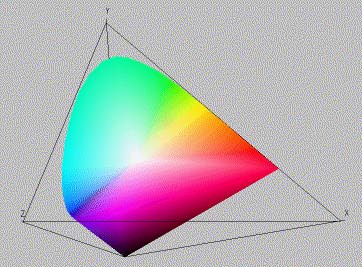
Two of the most common scales manufacturers currently are using to communicate colour and colour differences are the Hunter L, a, b and CIELAB. Hunter L, a, b was developed by the founder of Hunter Associates Laboratory Inc., Reston, VA, and finalized in 1958. CIELAB was adopted as an international standard in 1976. The first three letters of CIELAB stand for Commission Internationale de l'Eclairage, which is translated from French as the International Commission on Illumination. Both scales are in use, but CIELAB is gaining more support in some industries because it's an international standard and builds upon the Hunter scale.
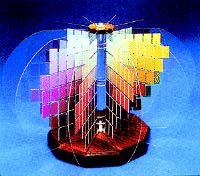 The Munsell system is considered visualy uniform because adjacent samples represent equal intervals of visual perception.
Both scales operate on the principle that some colours are darker than others (L, L*), that green and red are opposite, not typically combined, colours (a, a*), and that blue and yellow are opposite colours (b, b*). They also build upon two earlier attempts to measure colour. In the early 1900s, Albert Munsell developed a colour system based on visual perception. The Munsell system is considered "visually uniform" because adjacent colour samples represent equal intervals of visual perception. The system takes hue, value, and chroma into account. The next step in measuring colour was to quantify it. The tristimulus values (X, Y, Z), developed in the 1930s, do this, but don't make the communication of colour any easier than the Munsell System did. Hunter L, a, b and CIELAB quantify and communicate colour.
 Hunter L, a, b and CIELAB (L, a, b*) are based on the princple of opposite colours.
 Although CIELAB is considered to be theoretically better than Hunter L, a, b, it does have some limitations. For example, when the tolerances are set with the widest range in L*, a*, b*, samples that would be visually rejected may be within tolerance and when tolerances are adjusted to limit those values, good samples may be out of tolerance. In addition, sometimes when the total of L*, a*, b* is within tolerance, one component may be out of tolerance.
The G.I.A. Gemset and other commercially available gem colour grading systems are used in C.I.G.'s practical grading classes.
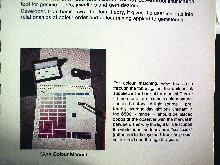
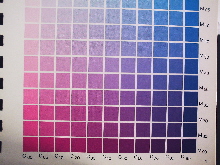


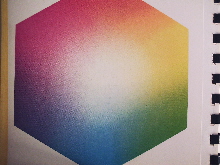
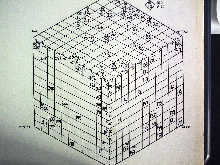

The original Gem Colour Manual by Wolf Kuehn, published in 1983 (Gemlab Research and Technology Group, Vancouver, B.C.)
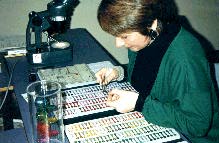 Glenda Christie, A.G. (C.I.G.)
using the GemSet grading system in C.I.G.'s Colour Gem Grading class
Glenda Christie, A.G. (C.I.G.)
using the GemSet grading system in C.I.G.'s Colour Gem Grading class
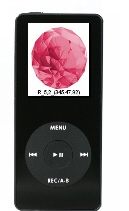

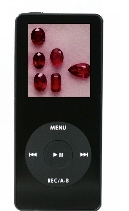
Our newest toy: 1.8" display MP4 player used as a portable colour grading tool.

 We are also using our portable Ocean Optics USB2000+ Miniature Fiber Optic Spectrometer and DT-Mini Deuterium Tungsten Halogen Light Source connected to a notebook computer for colour grading projects.
The new SpectraSuite, the first modular, OS-independent spectroscopy software platform runs on Windows, Linux and MacOS based systems.
 We have
experimented with inexpensive LED light sources of different colours.
They provide narrow emission bands which is much better suited for testing
purposes. The yellow LED can be used as a good monochromatic light source for
the refractometer.
We have
experimented with inexpensive LED light sources of different colours.
They provide narrow emission bands which is much better suited for testing
purposes. The yellow LED can be used as a good monochromatic light source for
the refractometer.
Unfortuantely very little has been written about the use of coloured LEDs and references to actual gems and their luminescence behaviour are almost non-existent.
An excellent Technology Update - Ultraviolet Light addressing this issue was published in The Guide in the Jan/Feb. 2007 edition - see links below. Perhaps it is time to compile a new set of reference data for luminescence spectroscopy.
With modern spectrophotometers we also can conduct
transmission/absoprtion/reflectance measurements in the non-visible ranges using
these new light sources.
Most newer white LEDs have negligible absorption in the blue and may be used as a strong light source for hand-held spectroscopes. More recently inexpensive and very strong 1 Watt LEDs have appeared; they have a balanced spectrum and are excellent for loupe and microscope work.
Deep UV LEDs are being developed and a 270 nm UV LED is now available for under $ 100. In combination with a UV-VIS spectroscope new exciting study fields may open up to the research gemmologist.
Gemmologists need to be aware of problems with commercial SW and LW ultraviolet light sources such as below.
 Mineralogical Short and Long Wave UV light;
see absorption spectrum below.


One can see that the SW light mercury spectrum (left) also shows a 365nm line which is the designated emission for the LW range when the lamp is switched to LW (right spectrum).


 Both the
inexpensive UV LED (very left) and the built-in UV light of the moissanite
tester have the same narrow emission at 395 nm.
Both the
inexpensive UV LED (very left) and the built-in UV light of the moissanite
tester have the same narrow emission at 395 nm.
We were curious and conducted luminescence spectroscopy on two synthetic
yellow diamonds first with the mineralogical SW/LW UV light source and then with
the 395nm LED light source from above. The results are surprisingly
different; it is quite possible that fluorescence may be activated by
varying energy sources in the 395 nm bulb!

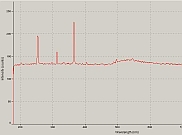

Above are 2 strongly fluorescent synthetic yellow diamonds (left deeper yellow, right synthetic of early Russian production) tested with the mineralogical SW UV light source. Despite some absorption in the SW area no information about the fluorescence of the diamonds could be obtained.
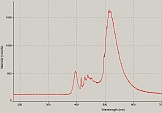
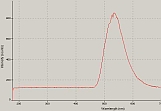
The same synthetic yellow diamonds (left deeper yellow, right synthetic of early Russian production) now tested using the 395nm LED light source: a clearly visible emission shift has occurred. This finding complies with the Stokes Law that the emission occurs at a longer wavelength (lower energy level) than the energy source used to excite the stone. As I am not a physicist I cannot provide you with a more detailled and scientific explanation of my observations.
All spectras were obtained with our UV/VIS/NIR Ocean Optics USB2000+ (200 - 850nm) spectroscope connected to high OH/SR fiber probes. We encourage gemmologists to conduct similar tests on other gemstones and report their findings.
For more information read the following articles: What is the best Lamp for Gemmology?  by W.B. Amos, Technology Update-Ultraviolet Light by Bear Williams and Gemstones and Light - The Science by Dana Schorr and Trish Odenthal, published in Gem
Market News, the Guide (May/June 2008).
by W.B. Amos, Technology Update-Ultraviolet Light by Bear Williams and Gemstones and Light - The Science by Dana Schorr and Trish Odenthal, published in Gem
Market News, the Guide (May/June 2008).
 Return to main page of Gemology World