

The GL Gem Spectrometer™ 2026 model with new motherboard and “Point & Shoot” software (Version 3.x). Now with integrated fast search spectral library of 200 gem references covering common Gemstones, Diamonds (incl. treatments) and PL405 spectra.
Introduction
We are proud to offer this economically priced and efficient portable spectrometer (UV-VIS-NIR, 300 – 1,000 nm, PL Spectroscopy) which can be operated from the USB port of a laptop computer. No additional drivers are necessary; the easy to learn GLGemSpec software displays both absorbance and transmittance spectra in real-time.
The best-selling GL Gem Spectrometer™ is an innovative and advanced gem testing instrument for gem dealers, mineral collectors, gemmologist appraisers and geoscience applications; it is also an excellent educational tool.
It helps to identify gemstones based on their spectral pattern and to analyze chromophores causing certain colours. It is probably the most important low cost diamond testing tool as it is capable to detect the Cape lines (98% of natural diamonds are Type Ia), the GR-1 band of irradiated diamonds, the Si center often seen in CVD grown diamonds (in many cases without LN cooling), possible HPHT treatments, whether green jadeite is naturally coloured or spinel is synthetic or heat treated and much more.
The unique gem light holder is mounted directly onto the spectrometer allowing fast real-time spectral analysis and bulk testing of both rough and faceted gemstones. It also has a built-in diffraction order sorting filter for elimination of second order effects when used with UV and laser excitation sources (PL spectroscopy, photoluminescence = fluorescence, phosphorescence). The GL Gem Spectrometer replaces the traditional hand-held spectroscope avoiding potential eye damage under strong halogen light.
Download the Promotional Flyer (PDF)
There are GLGemSpec users in over 40 countries around the world including: Australia, Austria, Belgium, Bolivia, Brazil, Bulgaria, Canada, Czech Republic, Cyprus, Georgia, Germany, France, Greece, Hong Kong, Hungary, Indonesia, Italy, Malaysia, Monaco, New Zealand, Philippines, Oman, Poland, Russia, Singapore, Slovakia, South Africa, Spain, Sri Lanka, Switzerland, Sweden, Taiwan, Thailand, Turkey, UK, USA, Vanuatu and Vietnam.
Please note: this is an advanced spectrometer which should be operated by a qualified gemmologist and/or spectroscopist.
I utilize my GLGemSpec to assist me in identifying and verifying gemstones from suppliers. The accuracy is better than the human eye in observing the spectral data. When there is something that does not appear as expected during testing I scrutinize the data more closely. Having the advantage of covering a large spectrum the GLGemSpec allows me to process more data about the products prior to sale or resale and assists in keeping records of those items. R. Kreinbrink, Owner, SOC Jewelry
I love my GL GemSpectrometer! It’s really quite simple to use, and it’s a fantastic help in my research in gem magnetism. Not just a tool for gem identification, I can use the spectrometer to identify specific metals that can cause gem color and magnetism. For example, with the spectrometer I can quickly and easily determine if a tourmaline is colored blue by copper, establishing whether or not it is a true Paraiba-type tourmaline. For my research, its important to know definitively which metals are causing color and magnetic response: is chromium causing red color in a particular gem, or is the red color due to iron?; is a strong magnetic response in a yellow gem due to iron or to manganese?; is a weak magnetic response in an orange gem due to the presence of chromium rather than iron? With the GL Gem Spectrometer, I can answer these questions myself without the need to send specimens off for costly lab tests. I can also save all my results on my computer for future reference, allowing me to establish a database of spectra for different gems and different metals. Kirk Feral, San Diego, CA www.gemstonemagnetism.com
The GL Gem Spectrometer is used at the German Gemmological Association (DGemG) in Idar-Oberstein, Germany as a teaching tool in their advanced gem identification classes and as a research tool for reflective spectrometry.
It is also used at The Mineral Technology Center (CETEM) – a research institute of the Ministry of Science, Technology and Innovation (MCTI) in Rio de Janeiro, Brazil and many other institutions around the world.
For proper identification of CVD grown diamonds we recommend the use of the GL Gem Spectrometer to detect any “Cape lines”(98% of natural diamonds are Type Ia). If not present inspect under microscope with crossed polarizer, download article here (PDF) or for more instructions from here (PDF).


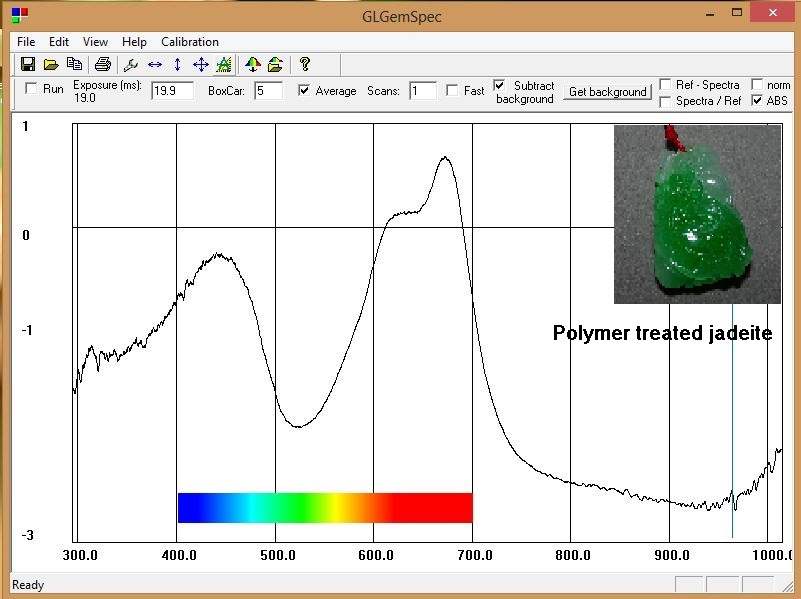

The GL Gem Spectrometer™ is very efficient in detecting whether green jadeite has been treated or not or whether the blue stone is one of the newer glass filled sapphires.


For your own protection always use laser safety goggles when operating any type of laser equipment.
Information Material
- PowerPoint Show (8 MB) ” UV-VIS-NIR Spectroscopy in Gem and Mineral Identification” by J.Wolf Kuehn
- How to Obtain a Spectrum with the GLGemSpec – (video, no sound) synthetic (flame fusion) ruby
- Using the GL Gem Spectrometer software – (video, no sound ) green glass (paste)
- Method to test if jadeite is naturally coloured – (video, no sound ) Untreated jadeite reference, dyed jadeite and nephrite
- How to Edit a GLGemSpec Spectrum in Spekwin32 – (video, no sound) green sapphire (Pailin, unheated)
- GL Gem Spectrometer and Advanced Gem Testing (PDF) – PowerPoint Presentation from the “ISG Lab Updates”, Tucson, AZ, Feb. 2011
- Article about the GL Gem Spectrometer in the French Revue de gemmologie AFG N 183 (2013)(PDF)
- Le Spectrometre UV-VIS-NIR GLGemSpec (PDF) – A presentation by Claude Lamarre, G.J., F.G.A., M.V. (in French)
Gemlab R&T Development and Support Team
- J Wolf Kuehn, B.A., M.A., PDP (SFU), Dipl.oec, F.G.G. – GLR&T Project Manager, Vancouver, B.C., Canada
- Stanislav O Konorov, Ph.D. (Laser Physics), Senior Staff Scientist, Dept. of Chemistry, University of Victoria, B.C., Canada
- Matthew Stockinger, B.A. (Chemistry, Mathematics), M.S. (Teaching), St. Cloud, MN, USA
- W. William Hanneman, Ph.D. (Chemistry) R.I.P.
Specifications of the GL Gem Spectrometer™
- Weight: 520 grams
- Dimensions: 170 mm x 84 mm x 59 mm
- Detector: Toshiba TCD1304DG linear array – Pixels: 3648 Pixel size: 8 um x 200 um
- Range: 300 – 1000 nm (optimized for VIS-NIR 400 – 950 nm range)
- Signal-to-noise ratio improved: 500:1, 16 bit A/D resolution; fast onboard averaging
- NEW: Gradient Filter for diffraction order sorting for elimination of second order effects (PL spectroscopy)
- NEW: upgrade-able motherboard with “Point & Shoot” software version 3.x and integrated spectral library of over 250 gem references of Gemstones, Diamonds and PL405 spectra (search function experimental).
- Wavelength and Optical resolution: 300-1000 nm < 1 nm
- Exposure time: 2.5 ms-10 s CCD reading time: 14 ms Data transfer speed: 200 ms / 100 ms (2 points binding)
- Fiber optic connector: SMA 905 to 0.22 numerical aperture single-strand optical fiber
- Power consumption: 200mA @ 5V from computer interface: USB 2.0, HID 2.0 (USB cable included)
- Operational system: Windows XP/Vista/Windows 7/8/10/11 (32/64 bit) – no additional software installation required.


Portable GL Gem Spectrometer™ System with GL Halogen 10W Gem Holder (included)
Package includes:
- GL Gem Spectrometer model 2026 (new motherboard, upgrade-able)
- GL Halogen 10 W Gem Holder (new modified design with extra SMA 905 port for external light sources)
- USB Cable to connect to USB port of computer
- 12/15 Volt power supply for light holder (110 – 240 V, international adaptors)
- USB stick with “point & shoot” software (version 3.x),“How to Get Started” instructions, reference materials
- “Pragmatic Spectroscopy for Gemologists” (2nd edition, 64 pages) by Hanneman/Kuehn
- Software integrated spectral library of 200 gem references (Gemstones, Diamonds and PL405 spectra)
- Access to data-base and 100 references in on-line image gallery. Supported by Spectragryph spectroscopy software.
PRICE US$ 2,395.00 FOB Vancouver, B.C., CANADA
Gemlab Research & Technology is manufacturer and exclusive distributor worldwide; we do not use re-sellers.


For work with darker gems and diamonds, larger samples and/or gems set in jewellery we recommend the GL Xenon Flashlight setup (see image). For photo-luminescence studies (PL spectroscopy) we recommend the GL Analyzer PL405 Kit which provides a blue laser (405 nm) and necessary accessories.
Using a fiber probe with the GL Gem Spectrometer requires a customized setup with external lighting and will change several parameters for obtaining a spectrum. Results may vary dependent on light source and its position, sample size (affecting path length) and orientation, etc.; spectra will look different from those found in the database and/or obtained with the GL 10W Halogen Gem Holder.
Specifications of the GL Halogen Gem Holder
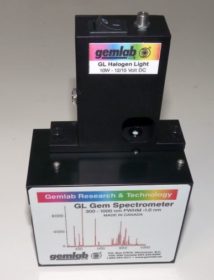
GL Halogen 10W Gem Holder with built-in cosine corrector, 20 x 20 mm opening and cooling fan. Similar to an integration sphere the built-in halogen light source is internally diffused by the holder’s black matte finish. The 2017 and newer model has an extra SMA 905 port which allows use of a fiber optics testing probe.
This unit is included in the basic GL Gem Spectrometer™ package.
Other light sources such as UV LED, Laser excitation, Deuterium lamp, Xenon flashlights, etc. can be used as shown below; a fiber probe will change optical parameters and resulting spectra may look different from those obtained in transmission mode.
- Weight: 80 gr
- Dimensions: 75 x 50 x 27 mm
- Size of opening: 20 x 20 mm
- NEW: SMA 905 port for use as an external light source and non-solarizing fiber optics probe.
- 15 V/1.5 A power adapter (110 – 240 Volts, international adapters) or battery power pack (optional)
This light holder has been optimized for the VIS-NIR 400 – 1000 nm range; there may be considerable noise below 400 nm.

System Requirements
The GL Gem Spectrometer™ requires a computer with a USB port (no separate drivers necessary, USB 2.0/HID 1.0 compliant).
The software package contains the GLGemSpec program (Windows XP/Vista/Win 7/8/10/11 for 32/64 bit); for developers the VIs and a runtime package for LabVIEW 2009 are included. A single user license is provided for each GL Gem Spectrometer system.
The new “point & shoot” GLGemSpec program (version 3.x) allows direct printing/saving (as image, reference spectrum, etc), automatic normalization in transmission and absorption mode; it has a spectral colour bar for reference and a zoom feature with a fixed range ( default 360 – 950 nm) and user defined range (from 300 – 1,000 nm).
The software works only with the modified firmware of the GL Gem Spectrometer.
Users of the GLGemSpec system have access to the Gemlab R & T spectra database which is available on-line.
Our Warranty and Commitment
The GL Gem Spectrometer is an advanced gem testing instrument for users who have a good understanding of spectroscopy and should be familiar with the use of a traditional gemmological spectroscope and the interpretation of spectra. The instrument is not capable of identifying or naming a sample; it should be used with other gem testing tools before arriving at a conclusion.
If you are not satisfied with the performance of the spectrometer we will accept returns within 10 days but have to charge a restocking fee of 10% to cover our expenses of shipping/handling and re-calibration if necessary. The purchaser is also responsible for the shipping and insurance to return the item.
We will repair and replace your GL Gem Spectrometer if necessary due to defective parts, etc during the first 6 months unless other consumer protection regulations exist in your country.
We also offer firmware/CCD upgrades for a processing fee of US$ 500 which covers the update, new software, re-alignment and re-calibration, etc. and return shipping charges; other repair services upon request. Software updates are always free.
Transmission Spectra (non-polarized and not normalized) obtained with the GLGemSpec
Note: Transmission dips correspond to dark lines or bands seen in a hand-held spectroscope


Converted and Normalized Absorption Spectra
The non-polarized spectrum of flame fusion ruby in the graph below shows corresponding absorption lines and bands as would be seen in a diffraction grating hand-spectroscope.
Corrected transmittance spectrum (non-polarized) of synth. flame fusion ruby as seen in the GLGemSpec interface: For example if transmission for certain wavelengths (in nm) is LOW absorbance for those wavelengths will be HIGH (in a conventional spectroscope one would see dark lines or bands at these positions; indicated as bars and lines).
Noise visible below 350 nm is due to limitations of the halogen light bulb.We improved readability in the 400 nm to 1000 nm range by using a higher voltage (15V) to drive the halogen bulb.
For experiments LW and SW UV LEDs can be used to illuminate samples in the light holder.


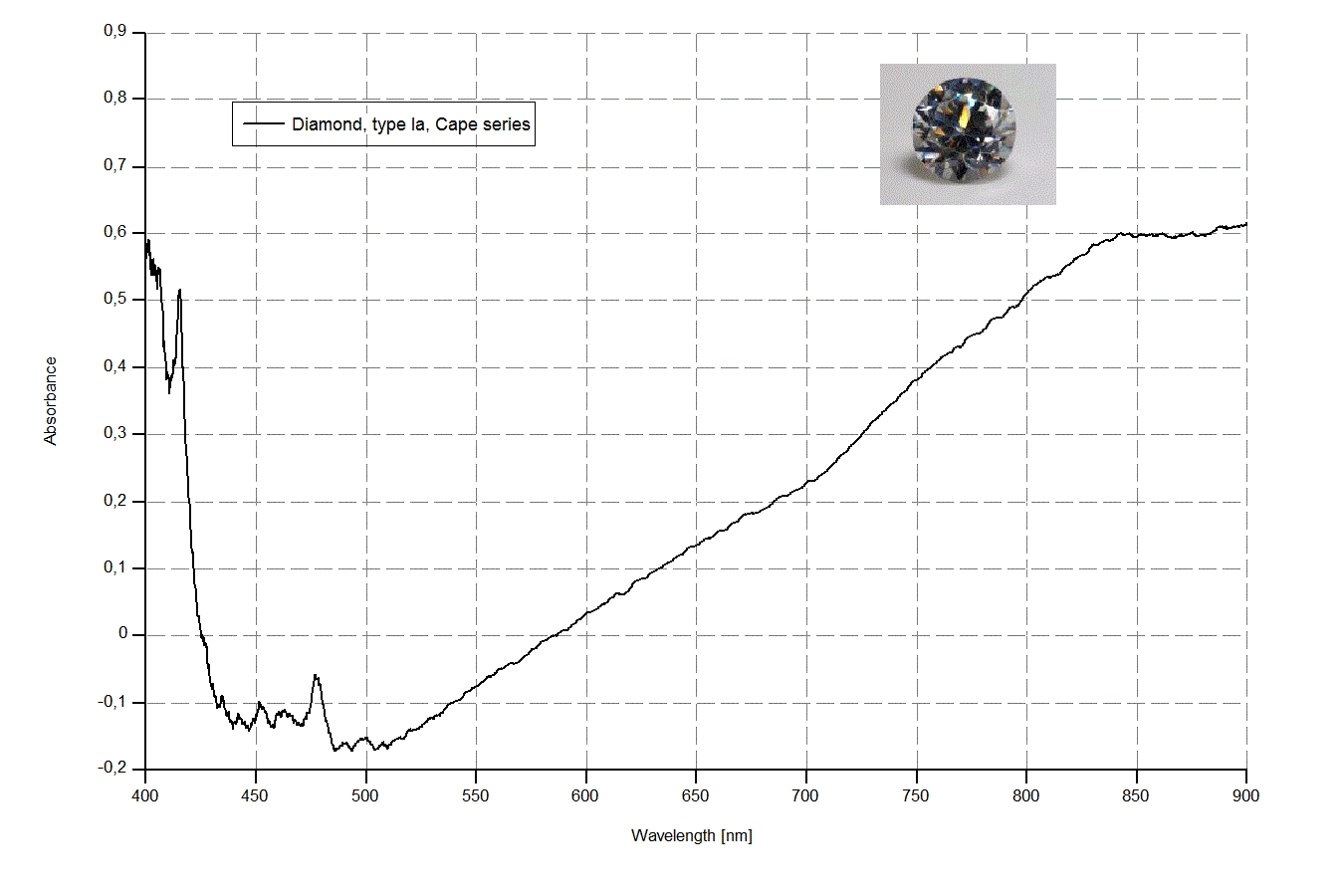


Colour-producing diamond defects not related to diamond type can be seen with the spectrometer (see peaks at 480, 550, 575, 595, 741 nm) – edited in Spekwin32


Download the archived GLGemSpec files “RubySynFlame.fak and Reference.fak” (.rar file), and import for smoothing, normalization, base-line correction, zoom, editing into Spekwin32 ( Download Spekwin32 revised version 1.71.6.1 from Nov 05 2012, file size: 1.3 MB by F. Menges).
About This Project
The GL Gem Spectrometer™ system has been under development for several years. My interest in spectroscopy goes back to Bill Hannemann’s book “Video-Spectroscopy: 21st Century Gemology” published in 1988. With 2 years of university physics in my academic background I was intrigued by Bill’s concept and saw its potential but Video Spectroscopy never took off the ground.
Almost 20 years later I started using an Ocean Optics USB 2000 (200 – 850 nm) spectrometer for research in the UV range and a NIR 256-2.5 spectrometer for IR studies – but I must admit that the GL Gem Spectrometer has replaced both; it is being used every day in the Gemlab Research & Technology lab and during courses I teach at the Canadian Institute of Gemmology (C.I.G.).
The maker of the spectrometer is a post-doctoral research scientist working at a local university; he is internationally acclaimed for his work and long list of publications about transmission and Raman spectroscopy (in particular its application in stem cell research).
I would like to thank Dr. Bill Hanneman (R.I.P.) for including the GL Gem Spectrometer in his book “Pragmatic Spectroscopy for Gemologists” with many reference spectra obtained from his own collection of gems; a copy of the 2nd edition is included with the purchase of each GLGemSpec system.
- A comprehensive database for absorption spectra of gems and minerals can be found at the Spectroscopy Server from California Institute of Technology
- For photoluminescence spectroscopy (532 nm green laser) go to “Complete List of luminescent minerals”


The GL Gem SpectrometerTM can be used in LabVIEW environment; VIs provided for developers.


Developer: J. Wolf Kuehn, B.A., M.A., PDP (SFU), Dipl. oec., F.G.A., F.G.G., Vancouver, B.C., Canada